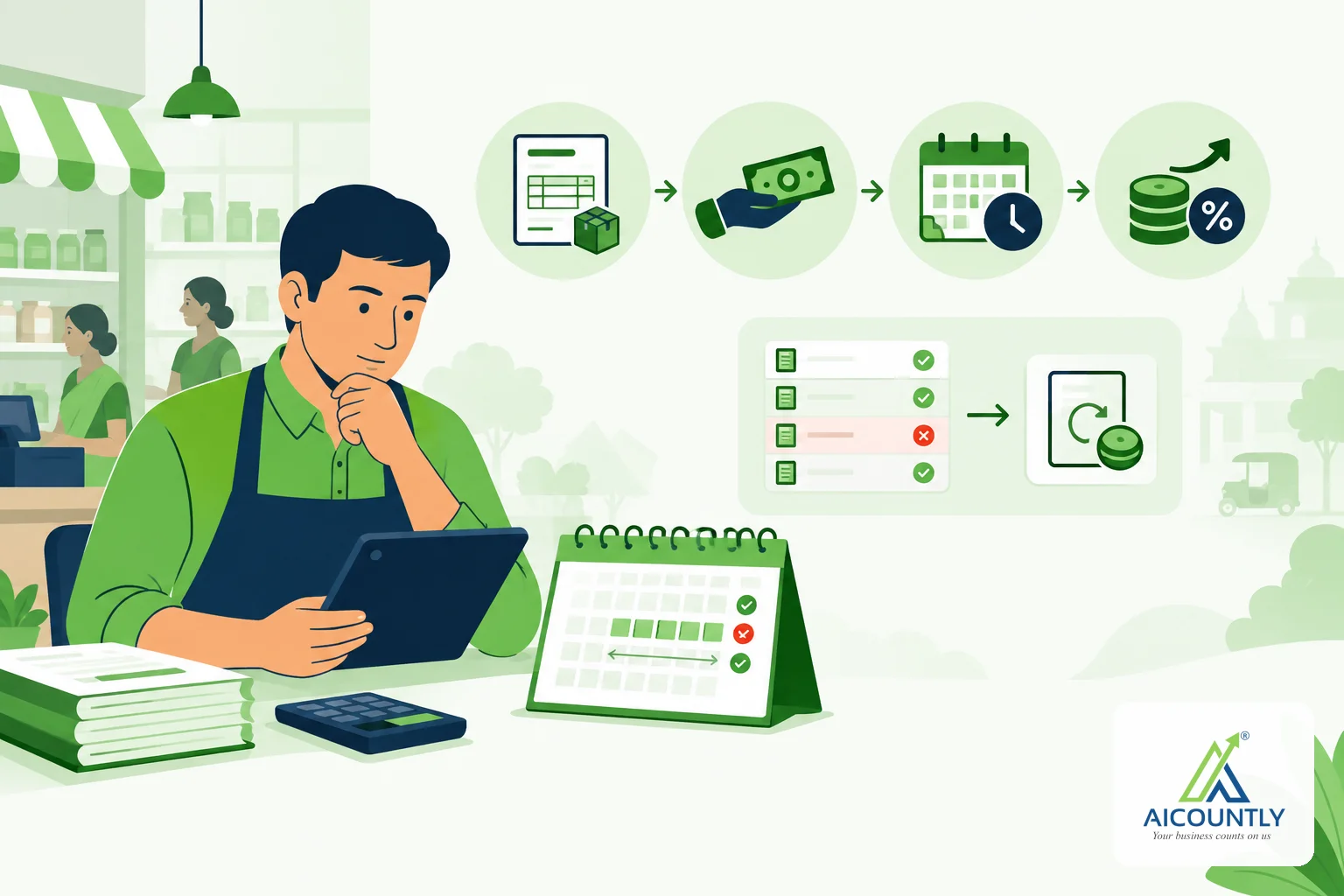
If you have not paid a supplier within 180 days of the invoice date, you may have to reverse the input tax credit (ITC) you claimed on that invoice and pay interest on it. This is the ITC reversal for non-payment within 180 days rule under Rule 37 of the CGST Rules, 2017, and it is easy to miss when your purchase ledger is long.
This guide explains what the rule says, how to spot the invoices at risk, how to reverse and re-claim credit, and what interest to expect. It is general guidance, so confirm specifics for your business with your CA.
What the 180-day rule says
Under the second proviso to Section 16(2) of the CGST Act, 2017, a registered person who has not paid the supplier the invoice value (along with the tax) within 180 days from the date of the invoice must add back the ITC claimed on the unpaid amount. The reversal is made through the GSTR-3B return, in the ITC reversal section.
Two points are worth remembering:
- The 180 days are counted from the invoice date, not the date you received the goods or booked the bill.
- The rule applies to the amount that is unpaid. If you have paid part of the invoice value, the reversal is generally proportionate to the unpaid part.
Which payments count
"Payment" here means payment to the supplier, usually by bank transfer, cheque, UPI or cash within the legal limits. Settling the dues by a credit note or a book adjustment against what the supplier owes you is a different situation, so ask your CA how your particular arrangement is treated.
Keep proof of payment against each invoice. A clear bank reference makes the audit trail simple. Our monthly bank reconciliation routine helps you match payments to purchase bills.
How to find invoices that are close to 180 days
- Export your purchase register and list every bill with an outstanding balance.
- Add 180 days to the invoice date of each one.
- Sort by that date and flag bills falling due for reversal in the next month.
- Decide which dues you will pay before the deadline and which you will have to reverse.
Doing this once a month, before you file GSTR-3B, is far easier than doing it once a year.
Worked example
Suppose a supplier issues you an invoice dated 1 April 2026 for ₹1,00,000 plus 18% GST of ₹18,000, and you claim the ₹18,000 as ITC. You pay nothing by 28 September 2026, which is the 180th day (counting the invoice date as day zero, the 180 days end on 28 September; confirm the count with your CA).
ItemAmount (₹) Invoice value including GST1,18,000 ITC claimed18,000 Amount paid within 180 days0 ITC to be reversed18,000If you had paid ₹59,000 (half) in time, the ITC to reverse would be roughly half, ₹9,000. The balance stays eligible.
Interest on the reversed ITC
When the reversal is required, interest under Section 50 of the CGST Act applies on the ITC reversed, at the rate notified for wrongly availed and utilised ITC, which is 18% per annum. The interest runs from the date the ITC was availed until the date it is reversed. Check the current rate and the computation method on the GST portal and with your CA before you pay.
Re-claiming the ITC after you pay
The reversal is not permanent. Once you pay the supplier, you can claim the ITC again, in the month in which the payment is made. The usual process is:
- Pay the supplier and note the date and reference.
- Show the re-availed credit in the ITC section of GSTR-3B for that month.
- Make sure the invoice still appears in your GSTR-2B, and that the Section 16(4) time limit has not passed. See our guide to the ITC time limit under Section 16(4).
Cases the rule does not cover
The 180-day condition has an exception for supplies where tax is paid by you under reverse charge, since you pay the tax yourself rather than the supplier. If you handle such purchases, read our explainer on the reverse charge mechanism. Also note that the notified rules can change, so check the latest CBIC notifications at cbic-gst.gov.in.
Habits that keep you safe
- Record the payment date and bank reference against every purchase bill.
- Review unpaid bills older than 120 days every month.
- Negotiate payment terms that fit inside 180 days, and remember the separate MSME rule in our Section 43B(h) guide.
- Keep the reversal and re-claim entries in your books so the GST ledger matches your returns.
Key takeaways
- Unpaid supplier invoices older than 180 days from the invoice date need an ITC reversal in GSTR-3B.
- Part payment means a proportionate reversal.
- Interest at 18% per annum under Section 50 applies on the reversed amount.
- You can re-claim the credit after paying, if the Section 16(4) time limit is still open.
- A monthly ageing review of unpaid purchase bills prevents surprises.
An accounting tool such as Smart Books can be a natural home for your purchase ledger and payment records, but whichever system you use, the discipline of tracking bill ages every month is what protects your credit. Please confirm your specific position with a Chartered Accountant.