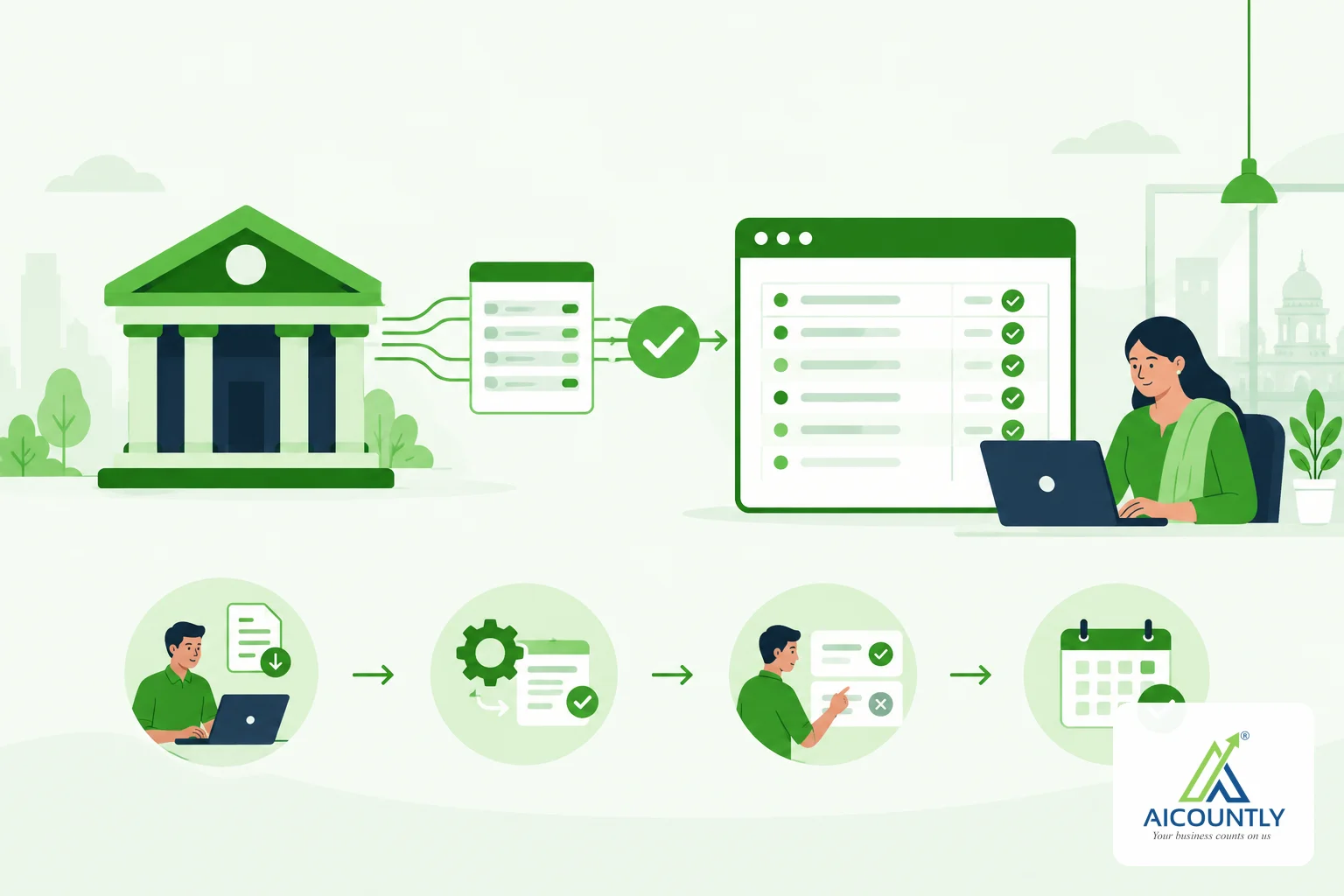
A bank reconciliation matches your books with your bank statement so that both tell the same story. If you are an Indian small business owner, doing it every month is one of the cheapest ways to catch errors, missed receipts and unauthorised debits before they become a year-end headache.
What is a bank reconciliation?
Your accounting records show what you think happened in the bank account. The bank statement shows what actually happened. A bank reconciliation compares the two for a period, usually a month, and explains every difference.
The closing balance in your books and the closing balance on the statement will often differ. That is normal. What matters is that you can explain the gap line by line.
Why differences arise
- Cheques issued but not yet cleared: you recorded the payment, the bank has not debited it yet.
- Deposits in transit: you recorded a cheque or cash deposit, but the bank credited it after month-end.
- Bank charges and interest: the bank debited fees or credited interest that you have not recorded.
- Direct credits and debits: customer UPI/NEFT/RTGS receipts, EMIs or standing instructions that reached the bank before reaching your books.
- Errors: wrong amounts, duplicate entries, or entries posted to the wrong account.
A simple monthly reconciliation routine
- Download the statement for the month from your bank, as a PDF or CSV.
- Note the opening balance and check it equals the previous month's reconciled closing balance.
- Tick off every statement line that matches an entry in your books by date, amount and party.
- List the unmatched statement lines. These are usually charges, interest or receipts you have not yet recorded. Record them.
- List the unmatched book entries. These are usually timing differences such as uncleared cheques. Keep them on the reconciliation list.
- Check that the adjusted book balance equals the adjusted bank balance. If not, look for a transposed digit, a duplicate or a missing entry.
- Save the statement and the reconciliation statement together for the month.
Worked example
Suppose the bank statement shows a closing balance of Rs 4,20,000 on 30 September, and your books show Rs 4,45,000.
ItemAmount (Rs) Balance as per bank statement4,20,000 Add: deposit in transit (cheque deposited 30 September, credited 1 October)40,000 Less: cheques issued, not yet presented(15,000) Adjusted bank balance4,45,000 Balance as per books4,45,000The two match, so the difference is fully explained by timing. Had the books said Rs 4,45,500, the Rs 500 gap would point to an unrecorded bank charge or an entry error that needs investigating.
Why it matters for GST and TDS
Reconciled bank entries give you reliable dates and amounts for receipts and payments. That helps when you prepare returns, for example the GSTR-1 checklist for October 2026, and when you deposit tax on time, as in our guide to TDS and TCS deposit for October 2026. It is also a core step in the half-year book closing checklist.
It also supports vendor payment discipline. If you owe money to micro and small enterprises, accurate payment dates matter, as explained in our article on Section 43B(h) and the 15 and 45 day rule.
Common mistakes to avoid
- Reconciling only at year-end, when memory of individual transactions has faded.
- Posting a lump-sum bank credit to one customer when it covers several invoices.
- Ignoring small unexplained differences. Small gaps often hide duplicates or wrong entries.
- Leaving old uncleared cheques on the list for months without following up or reversing them.
- Reconciling cash and card or UPI settlement accounts less carefully than the main current account.
Key takeaways
- Reconcile every bank account at least monthly, not just at year-end.
- Start from the previous month's reconciled balance and explain every difference.
- Timing differences are normal; unexplained differences are not.
- Keep the statement and reconciliation together for your records.
Whether you work in a spreadsheet or in accounting software, a fixed monthly date for reconciliation makes the habit stick. For anything specific to your business, such as treatment of particular receipts, confirm with your chartered accountant.