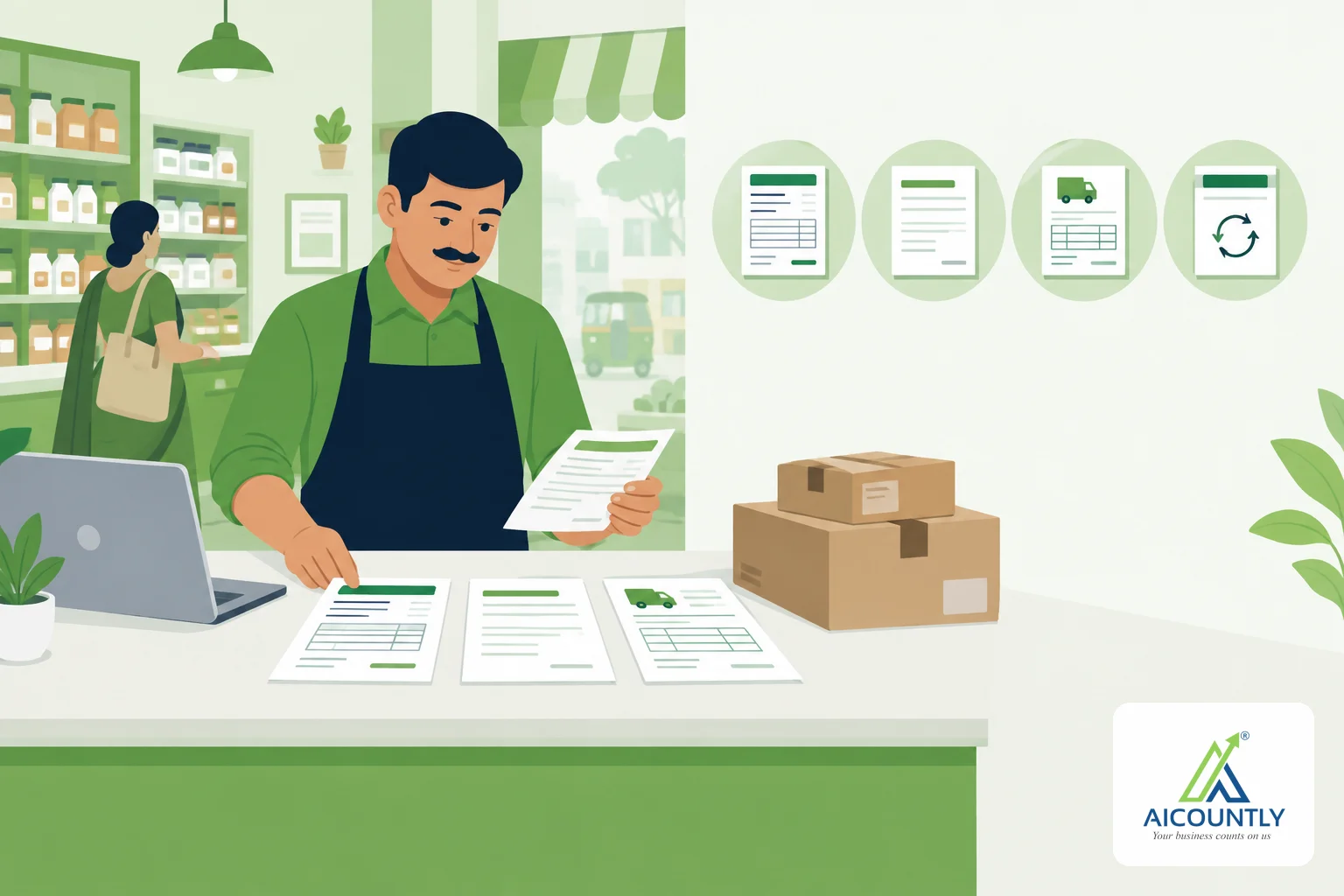
Not every sale needs a tax invoice. Depending on what you supply and who you are, GST law expects a tax invoice, a bill of supply, a delivery challan, or a note that adjusts an earlier invoice. Using the wrong document is one of the easiest mistakes to make, and it can affect your customer's input tax credit and your own GST returns.
The four documents at a glance
DocumentWhen it is usedTax charged? Tax invoiceTaxable supply of goods or services by a registered personYes Bill of supplyExempt or nil-rated supplies, and supplies by a composition taxpayerNo Delivery challanMoving goods when the movement is not a sale, or when the invoice cannot be issued at dispatchNo Credit or debit noteAdjusting the value or tax of an invoice already issuedAs per original invoiceWhen to issue a tax invoice
If you are a registered person making a taxable supply, you issue a tax invoice. The mandatory fields are set out in Rule 46 of the CGST Rules; our GST tax invoice checklist walks through them one by one.
Timing matters too. For goods, the invoice is generally issued at or before removal of the goods or delivery to the recipient. For services, it is generally issued within 30 days of the supply (a longer period applies to insurers, banks and certain financial institutions). Check the exact time-of-supply rules for your case.
A small relaxation exists for sales to unregistered customers: where the invoice value is less than ₹200 and the customer does not ask for an invoice, you may issue one consolidated invoice for the day's such sales.
When a bill of supply is the right document
A bill of supply is issued instead of a tax invoice in two common situations:
- Exempt or nil-rated supplies. If everything you sell is exempt, you do not charge GST, so you issue a bill of supply.
- Composition scheme. A composition taxpayer cannot collect tax from the customer. The bill of supply should carry the words "composition taxable person, not eligible to collect tax on supplies".
If you sell both taxable and exempt items, use a tax invoice for the taxable supplies and a bill of supply for the exempt ones. Never show GST on a bill of supply, and never use a bill of supply for a supply on which tax is payable. The relevant provision is Rule 49 of the CGST Rules.
When a delivery challan is used
A delivery challan accompanies goods when there is no sale at that moment, or when the invoice is not ready at dispatch. Typical examples are:
- Sending goods to a job worker for processing.
- Sending goods on approval, where the sale may or may not happen.
- Transporting goods for reasons other than supply.
- Moving a large consignment in parts, where a challan travels with each part and the invoice is issued later.
Rule 55 covers the contents of a challan: serial number, date, consignor and consignee details, description, quantity, taxable value, tax rates and place of delivery. A challan is not a substitute for a tax invoice when a taxable sale has actually happened. Where an e-way bill is required, see our guide to e-way bill basics.
Changing an invoice later: credit and debit notes
You do not edit or cancel a tax invoice quietly once it is issued and reported. If the taxable value or tax changes, for example because of a return, a price correction or a post-sale discount, you issue a credit note or a debit note linked to the original invoice. The rules and time limits are explained in GST credit notes under Section 34.
Common mistakes to avoid
- Charging GST on a bill of supply issued by a composition taxpayer.
- Moving goods on an informal slip instead of a proper challan.
- Skipping the invoice because a challan was already issued for a completed sale.
- Breaking the serial number sequence, or issuing duplicate numbers.
- Reporting a document in the wrong return table, which can cause mismatches later. See how to file GSTR-1 without common mistakes.
Key takeaways
- Taxable supply by a registered person: tax invoice.
- Exempt, nil-rated or composition supply: bill of supply, with no GST shown.
- Goods moving without a sale, or before the invoice is ready: delivery challan.
- Changes after invoicing: credit or debit note, never a silent edit.
- When a case is unusual, confirm with your CA before choosing the document.
Keeping these documents consistent is far easier when your invoicing and books sit together. AICOUNTLY's Billing app is built for Indian GST invoicing; this article is general guidance, so please confirm your specific position with a chartered accountant.