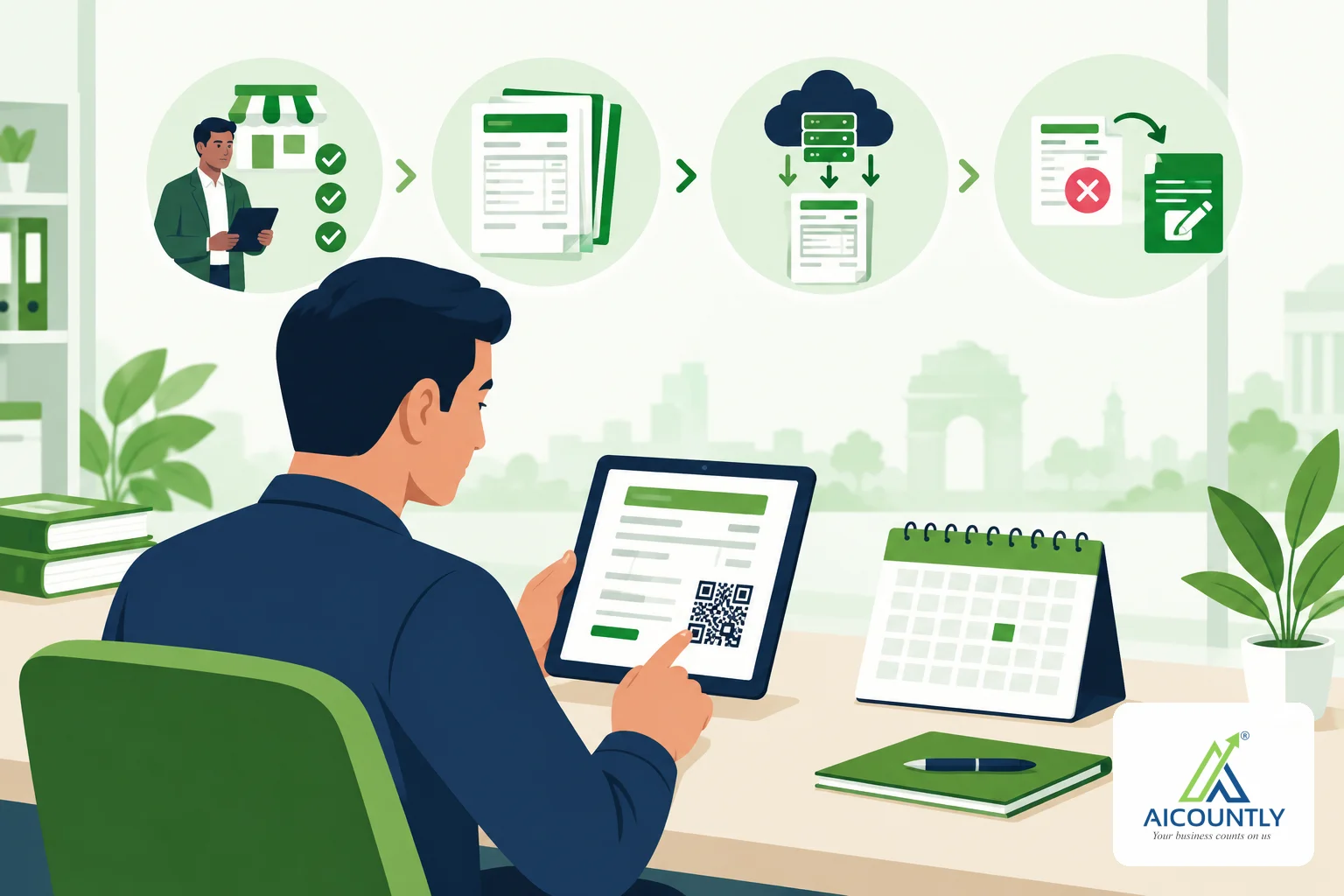
The right accounting software for a GST-registered business is the one that keeps your books, your GST returns and your bank statement in agreement without extra spreadsheets. Before you buy anything, test it against the monthly GST routine you actually follow, not against a feature list.
This guide gives you a practical checklist for choosing accounting software for GST-registered businesses: what to test, which questions to ask, and how to run a short trial.
Start with your own monthly routine
Write down what happens every month in your business: raising sales invoices, booking purchase bills, paying suppliers, matching the bank, preparing GSTR-1 and GSTR-3B, and handing papers to your CA. The software should shorten these steps. If you cannot describe the routine, you cannot judge the tool.
Also note the size of the job. A shop with 40 invoices a month needs something different from a distributor with 2,000 invoices, several GSTINs and a godown in another state.
Check that GST is built into every voucher
GST should not be an add-on report. Open the sales invoice screen and check these points:
- Does it split CGST, SGST and IGST automatically based on place of supply?
- Can you set HSN/SAC codes and rates per item or per line?
- Does it handle reverse charge, exports, credit notes and debit notes?
- Can the invoice carry the mandatory fields of a tax invoice? See our guide on the e-invoicing and IRN rules if your turnover may bring you into e-invoicing.
If rates change, you also want a history of the rate used on each older invoice rather than a silent overwrite.
Look at returns and registers, not just reports
Ask the vendor to show you the supply outward register, the inward register, HSN-wise summaries and a document summary. These are the working papers behind GSTR-1 and GSTR-3B. Aicountly Smart Books, for example, groups its GST area into returns, summaries, registers, reconciliation, audit and e-way/e-invoice sections, so you can see where each figure comes from.
A return that you cannot trace back to vouchers is a return you cannot defend in a notice. Drill-down from a total to the invoice behind it is the feature to test first.
Reconciliation is where software earns its fee
Most GST errors are mismatches: sales in your books versus GSTR-1, purchases versus GSTR-2B, tax paid versus tax in the ledger. Read our checklist on GSTR-1 versus GSTR-3B reconciliation and then ask whether the software does the same comparisons.
Specific things to test:
- GSTR-2B matching. Can you compare supplier invoices from GSTR-2B with your purchase bills and tag input tax credit (ITC) as accepted, pending or not eligible?
- Missing purchases. If a bill appears in GSTR-2B but not in your books, can you create the purchase from it and see what details are still missing, such as the supplier ledger or the purchase ledger?
- Books versus returns. Can you compare GSTR-1 and GSTR-3B with what your ledgers show?
- Electronic ledgers. Can you compare the electronic cash and credit ledgers with your books?
Aicountly Smart Books has a GST Reconciliation Centre with GSTR-2B, GSTR-1 and GSTR-3B reconciliation, an Accounts vs GST view and an ECL (electronic cash and credit ledger) reconciliation. Whatever you shortlist, ask for the same checks on your own sample data.
Do not ignore the bank and TDS side
GST is only one part of compliance. A GST-registered business usually deducts TDS too, and needs a monthly bank match. Check that the tool offers a bank reconciliation report, party-wise outstanding and TDS handling on vouchers. Our bank reconciliation routine shows what a good month-end match looks like, and the TDS basics guide lists what you need on each deduction.
Practical questions on cost, access and support
- Multiple GSTINs and branches. Can one login manage several registrations, with branch-level access control?
- Users and roles. Can your accountant or CA get access without sharing your password?
- Data export. Can you export your data in standard formats if you ever change tools?
- Imports. Can you bring in opening balances and masters from spreadsheets?
- Support. Is help available in a time zone and language your team uses, especially near due dates?
- Price. Ask what is included. Some plans charge extra for users, branches or e-invoicing.
Run a two-week trial with real data
Do not judge by a demo. Take one real month and:
- Import your masters and opening balances.
- Enter 20 sales invoices and 20 purchase bills, including one credit note and one reverse-charge purchase.
- Pull the outward register and compare the totals with your last filed GSTR-1.
- Run a purchase reconciliation against GSTR-2B and note how many mismatches the software explains.
- Ask your CA to review the output and tell you what they would still need to rework.
If the trial feels slower than your spreadsheet after the first week, ask why before paying. Setup time is normal; daily friction is not.
Key takeaways
- Choose against your own monthly GST routine, not a feature list.
- GST fields, HSN/SAC and place-of-supply logic must sit inside every voucher.
- Insist on drill-down from return totals to individual invoices.
- Test GSTR-2B, GSTR-1 and GSTR-3B reconciliation on your own data.
- Check bank reconciliation, TDS, multi-GSTIN access and data export too.
- Trial with one real month and get your CA's opinion before committing.
If you want to see this kind of GST-first workflow in practice, Aicountly's Smart Books brings vouchers, GST returns, reconciliation and bank matching into one place. Whichever tool you choose, confirm tax positions and due dates with your CA and the official GST portal, since rules and extensions can change.