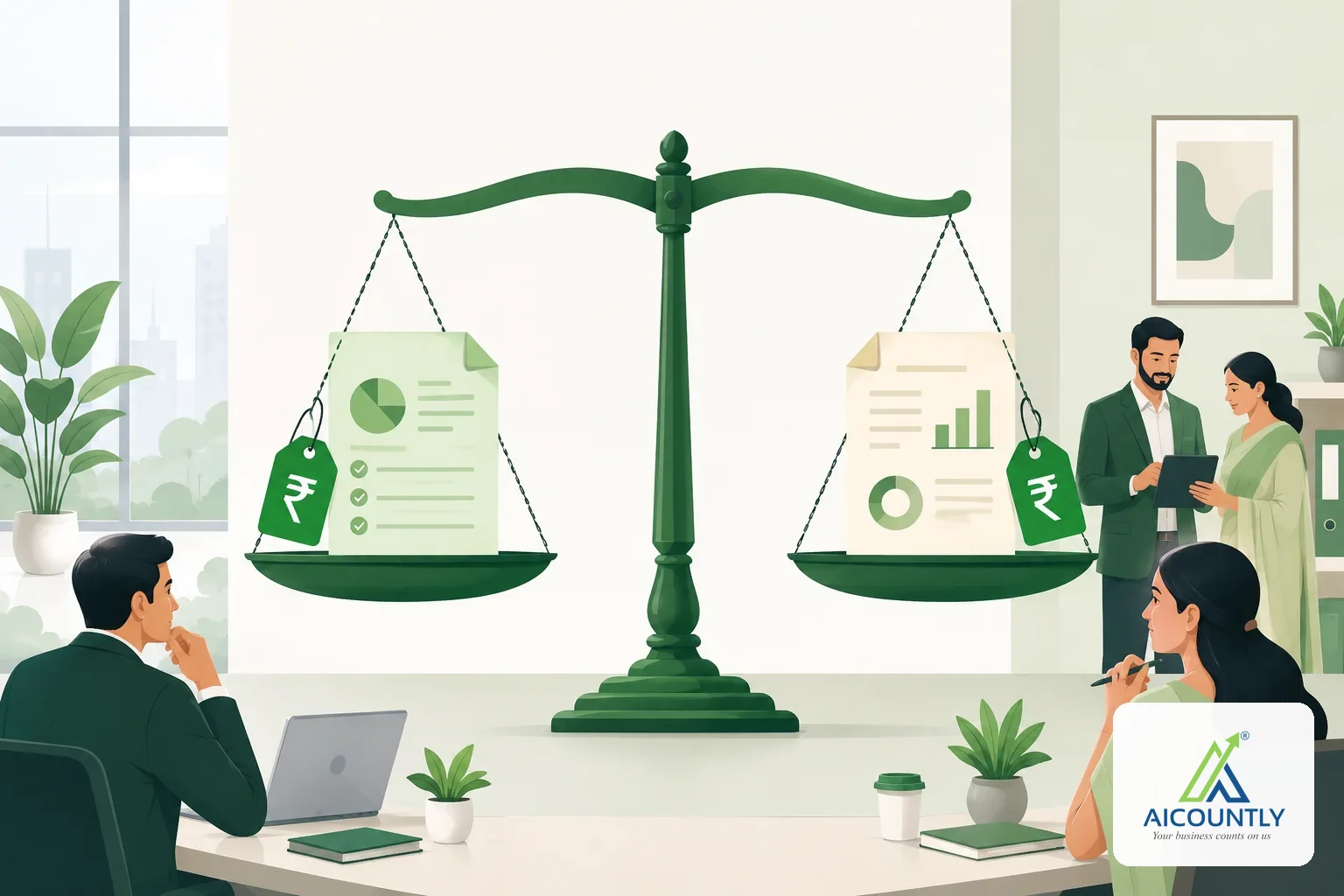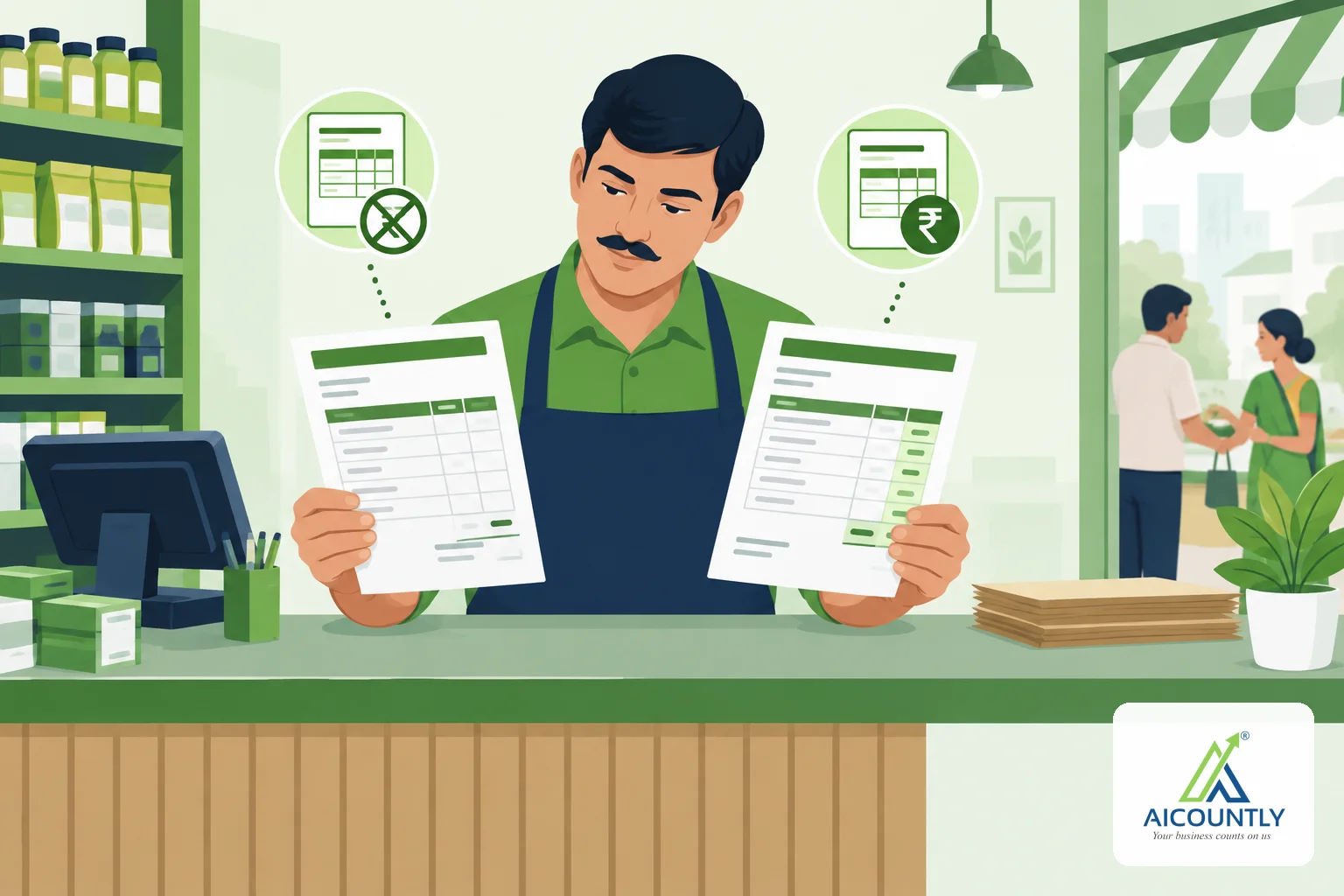
The difference between a bill of supply and a tax invoice comes down to one thing: whether GST is charged. A tax invoice is issued when you charge GST on a taxable supply. A bill of supply is issued instead when you cannot or need not charge GST, because you are a composition dealer or the goods or services are exempt. Getting this wrong affects your customer's input tax credit and your own return, so it is worth being precise.
This article goes a step deeper than a general comparison of GST documents. If you also want to see how a delivery challan fits in, read our guide on tax invoice, bill of supply or delivery challan.
The short answer: bill of supply vs tax invoice
PointTax invoiceBill of supply Is GST charged?Yes, shown separatelyNo GST is charged Who issues it?A registered person making taxable suppliesA registered person making only exempt supplies, or a composition dealer Can the buyer claim ITC?Yes, if the other conditions are metNo, because no tax was charged Main provisionSection 31 and Rule 46 of the CGST RulesSection 31(3)(c) and Rule 49Who must issue a bill of supply?
Under Section 31(3)(c) of the CGST Act, a registered person supplying exempt goods or services, or paying tax under the composition scheme (Section 10), issues a bill of supply instead of a tax invoice. In practice that covers two groups:
- Composition dealers. You pay tax at a flat rate on turnover and cannot collect GST from customers. Your bill of supply should carry a line such as "composition taxable person, not eligible to collect tax on supplies".
- Suppliers of exempt goods or services. If everything you sell is exempt (for example, certain unprocessed foods or specified services), you issue only bills of supply.
What a bill of supply should contain
Rule 49 lists the particulars. It is a shorter list than a tax invoice because there is no tax to show. Broadly, you include:
- Your name, address and GSTIN.
- A consecutive serial number, unique for the financial year.
- The date of issue.
- The recipient's name, address and GSTIN, where the recipient is registered.
- Description of the goods or services, quantity and the value of supply.
- Your signature or digital signature.
Compare this with the long list in GST tax invoice: the mandatory fields under Rule 46. There is no tax rate, no taxable value and no tax amount on a bill of supply.
When a business needs both: invoice-cum-bill of supply
Many small businesses sell some taxable items and some exempt items. Rule 46A allows a registered person who supplies both taxable and exempt goods or services to an unregistered buyer to issue a single "invoice-cum-bill of supply". This keeps the counter workflow simple, but the document still has to show GST correctly against the taxable lines and none against the exempt ones. For a registered buyer, many businesses prefer separate documents so the tax treatment of each line is unambiguous.
Small-value sales and consolidated bills
Rule 49 has a relaxation for low-value sales. Usually, a bill of supply need not be issued if the value of the supply is below ₹200 and the buyer does not ask for one, provided you raise a consolidated bill of supply at the end of the day for such sales. Check the current text of Rule 49 on the CBIC website before relying on this, as limits and conditions can change.
Common mistakes to avoid
- Charging GST on a bill of supply. A composition dealer cannot collect tax from customers. Showing tax on the document causes problems for you and your buyer.
- Issuing a tax invoice for an exempt supply. Your buyer may try to claim ITC on tax that should never have been charged.
- Forgetting the document type when you move from composition to regular. From the date you switch, you issue tax invoices and charge GST. Review your templates and numbering.
- Mixing serial numbers carelessly. Keep a clear, consecutive series for each document type so your records and your GST return line up.
How this shows up in your returns
Exempt, nil-rated and non-GST outward supplies go in the relevant table of your GSTR-1, not in the taxable tables. If you are reconciling your sales before filing, our article on GSTR-3B due on the 20th explains how to avoid interest and late fees on the monthly return. Due dates are usually the 11th for GSTR-1 and the 20th for GSTR-3B, but check the GST portal for any extension.
Key takeaways
- A tax invoice charges GST; a bill of supply does not.
- Composition dealers and suppliers of exempt goods or services issue a bill of supply (Section 31(3)(c), Rule 49).
- Buyers cannot claim ITC on a bill of supply.
- If you sell both taxable and exempt items to unregistered buyers, an invoice-cum-bill of supply (Rule 46A) may work.
- Always keep a consecutive series and confirm specifics with your CA.
If you are choosing software to manage this, our GST billing software checklist lists what to look for, and Aicountly Billing is built for Indian GST invoicing. This article is general guidance, so confirm your specific case with a chartered accountant.