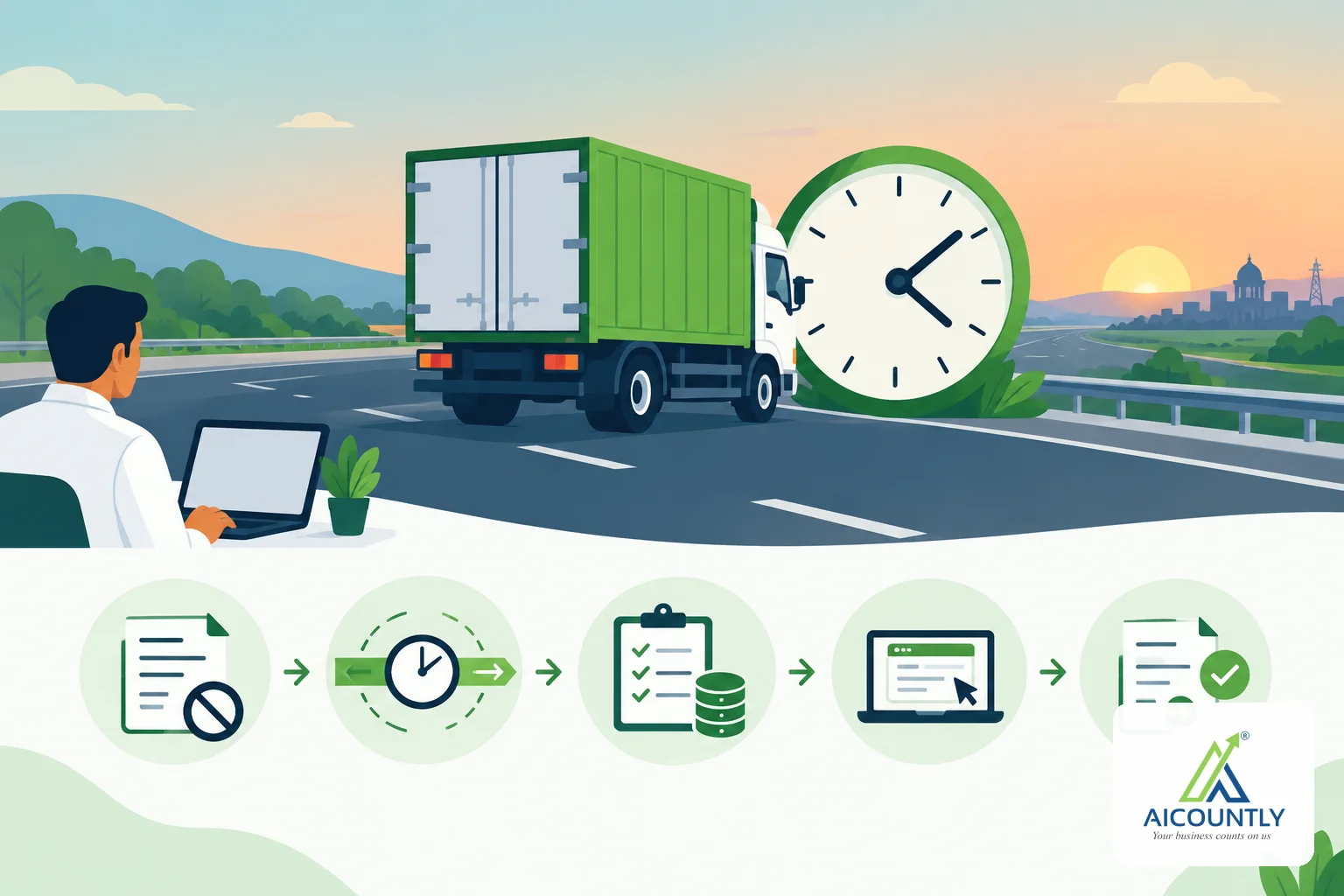
If you file GST returns quarterly under the QRMP scheme, you still have to pay tax every month. For the first two months of the quarter, you pay using challan PMT-06, and for October 2026 the usual due date is 25 November 2026. This guide explains who pays, the two ways to work out the amount and what a late payment costs.
What PMT-06 payment under QRMP means
QRMP (Quarterly Return Monthly Payment) lets small taxpayers file GSTR-1 and GSTR-3B once a quarter instead of every month. The tax itself is not deferred. You deposit the tax for month one and month two of each quarter by the 25th of the following month, and settle the balance for the third month along with the quarterly GSTR-3B.
For the October to December 2026 quarter, that means the October payment falls on 25 November and the November payment on 25 December. The December balance goes with the quarterly GSTR-3B. These are the statutory default dates. Before you pay, check the GST portal for any notification that changes them.
Who has to pay monthly
- Registered taxpayers who opted into QRMP, which is generally open to those with aggregate turnover up to Rs 5 crore in the preceding financial year.
- Taxpayers who file GSTR-3B quarterly and pay tax in the first two months of each quarter.
- Not applicable if you file GSTR-3B every month. Your monthly GSTR-3B due on the 20th already carries the payment.
If your net cash liability for a month is nil, you do not need to create a challan for that month. Your net liability depends on the tax you owe less the input tax credit (ITC) you can use.
Two ways to calculate the amount
Fixed Sum Method
The portal can generate a pre-filled PMT-06 for you. Under the fixed sum method, the amount is a set percentage of the tax you paid in cash in the previous quarter. The rule is generally 35 per cent of the cash paid in the last quarter's GSTR-3B for quarterly filers. If you filed monthly in the previous quarter, it is usually 100 per cent of the cash paid in the last month of that quarter. Confirm the exact amount shown on the portal when you generate the challan.
This method suits you when your sales are steady and you want to keep things simple. You do not need to prepare detailed working for the first two months.
Self-Assessment Method
Under the self-assessment method, you work out the actual tax for the month on invoices issued, subtract the ITC you are entitled to use and pay the net cash amount. You also need to account for the ITC available in your electronic credit ledger and, where it is relevant, any tax reversals.
Use this method when your sales swing a lot, or when a big purchase in the month gives you a lot of ITC. A fixed sum could make you pay more cash than needed.
Steps to pay on the GST portal
- Log in to the GST portal and go to Services > Payments > Create Challan, or use Services > Returns > Payment of tax for QRMP, depending on the menu available to you.
- Choose the month and the method (fixed sum or self-assessment).
- Check the amount for each head: IGST, CGST, SGST/UTGST and cess.
- Generate the challan and pay by net banking, UPI, card or another listed mode.
- Download the challan and keep a copy with your records.
The payment is credited to your electronic cash ledger. When you file the quarterly GSTR-3B, the amount paid in months one and two is adjusted against the quarter's total liability.
What a late or short payment costs
If you pay after the 25th, interest under section 50 of the CGST Act applies to the unpaid tax. The usual rate is 18 per cent a year, counted from the day after the due date until the day you pay. Paying less than the correct amount creates the same exposure for the shortfall. Interest is worked out on the net cash liability, not on the gross tax.
A late payment for months one or two does not by itself attract a late fee on a return, but the interest adds up and shows up when you file the quarterly GSTR-3B. Ask your CA how to handle a particular case, such as a nil month or a mismatch with your sales.
Common mistakes to avoid
- Assuming QRMP means you can wait until the quarter ends to pay.
- Choosing the fixed sum method and forgetting that you must stay consistent within the quarter.
- Paying through the wrong head, such as IGST instead of CGST and SGST.
- Not matching the payment to the invoices you uploaded in the Invoice Furnishing Facility (IFF). See our guide on QRMP and the IFF on the 13th.
- Skipping the ITC check before the payment. Read GSTR-2B reconciliation before GSTR-3B for a practical method.
Plan the rest of the quarter
Put the 25th of each month on your calendar and keep the quarterly return in view. Our checklist for quarterly GSTR-3B under QRMP shows what to prepare, and the post on GSTR-3B interest and late fee covers the monthly case.
Key takeaways
- QRMP changes how often you file, not how often you pay: tax for months one and two is due by the 25th.
- For October 2026, the usual due date is 25 November 2026. Check the GST portal for any extension.
- Pick the fixed sum method for simplicity or the self-assessment method for accuracy when sales vary.
- Late payment attracts interest under section 50, generally at 18 per cent a year.
- Keep the challan and match it to your invoices and ITC before you file the quarterly return.
If you keep your books in Smart Books, its GST section includes a liability and ITC comparison that sets the GSTR-1 / 2B figures beside GSTR-3B, which helps you see where numbers differ before you pay. This article is general guidance, so confirm specifics for your business with a CA.