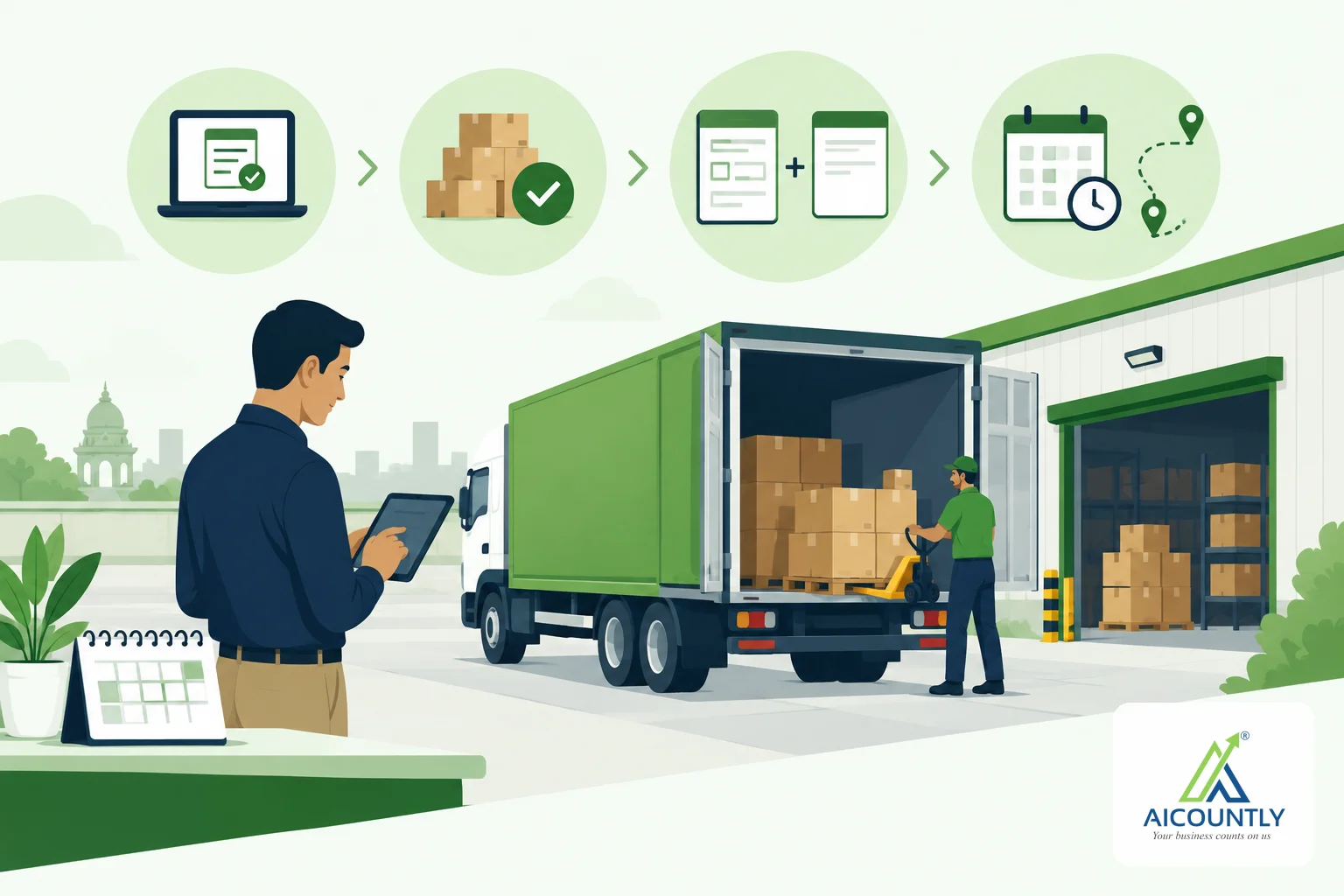
An e-way bill is an electronic document that must usually accompany goods worth more than ₹50,000 when they move by road, rail, air or ship. If you are wondering whether an e-way bill is needed for a particular consignment, the short answer is: check the value, the type of movement and the nature of goods, then generate it on the e-way bill portal before the vehicle starts.
This guide explains the basics in plain words, the common situations where people get stuck, and a checklist you can follow each time goods leave your premises. Rules and limits change by notification, so treat this as general guidance and confirm specifics with your CA or the official portal.
What is an e-way bill and who generates it?
The e-way bill is generated online from the e-way bill portal (ewaybillgst.gov.in) using details of the invoice or delivery challan. It carries a unique 12-digit number. Under the GST rules, the registered person who causes the movement of goods generally generates it. Depending on the situation, that can be the supplier, the recipient or the transporter.
- Supplier: usually generates it when sending goods to a customer.
- Recipient: may generate it when buying from an unregistered supplier and arranging the transport.
- Transporter: can generate it on behalf of the consignor or consignee, based on the details they provide.
When is an e-way bill required?
As a general rule, an e-way bill is required when the value of the consignment exceeds ₹50,000. Value here means the value of goods in the invoice, bill of supply or challan, including taxes, as per the rules. Some points to keep in mind:
- The movement can be a supply, but also a return, a job-work movement or a transfer between your own branches.
- Certain goods are exempt from the requirement, and states may have their own rules for movement within the state. Check the current notification for your state.
- Even below ₹50,000, some movements, such as certain job-work or handicraft cases, have special provisions. Do not assume; verify.
Part A and Part B: what you fill in
The e-way bill has two parts. Part A holds the GSTIN of the recipient, place of delivery, invoice or challan number and date, value, HSN code and reason for transport. Part B holds the vehicle number. If the transporter is not yet decided, you can enter Part A first, but a valid e-way bill needs the vehicle details in Part B before the goods actually move.
Validity: how long does it last?
Validity depends on the distance travelled. For regular cargo, the usual rule is one day for every 200 km or part of it. For over-dimensional cargo, it is one day for every 20 km or part of it. The validity is counted from the time the e-way bill is generated, and it ends at midnight of the last day. If the goods are delayed by a breakdown or a strike, the person in charge of the goods can extend the validity within the permitted time window, with a valid reason.
Type of cargoUsual validity Regular cargo1 day per 200 km or part thereof Over-dimensional cargo1 day per 20 km or part thereofCommon mistakes that cause trouble on the road
- Wrong vehicle number: if the vehicle changes mid-journey, update Part B. Do not let the driver carry a bill that names a different vehicle.
- Wrong GSTIN or pin code: distance is calculated from pin codes. An incorrect pin code gives a wrong validity.
- Value mismatch: the e-way bill value should match the invoice. Mismatches invite questions during inspection.
- Late generation: generating the bill after the goods have already left puts you at risk during a check.
- Not cancelling in time: if the goods are not sent, you can cancel the e-way bill within 24 hours of generation, provided it has not been verified in transit.
A simple pre-dispatch checklist
- Confirm the invoice or challan is complete and the GST details are right. Our guide on the mandatory fields of a GST tax invoice can help.
- Check the consignment value against the ₹50,000 threshold and any state-specific rules.
- Enter the correct HSN code, pin codes and transport details.
- Generate the e-way bill and share the number and a printed or digital copy with the driver.
- Keep a copy with your records so it can be matched with your GSTR-1 filing later.
Key takeaways
- An e-way bill is generally needed when goods worth more than ₹50,000 move, subject to exemptions and state rules.
- Generate it before the vehicle starts; keep Part B (vehicle) current.
- Validity depends on distance: one day per 200 km for regular cargo.
- Match the e-way bill with the invoice and keep clean records for your returns.
- Check the official portal for current limits and notifications, and ask your CA when in doubt.
Clean records make dispatch checks easier. If you want one place for your invoices, books and reports, you can explore Smart Books and see whether it fits how your business works.