Blocked credit under Section 17(5) is input tax credit (ITC) that the GST law does not allow you to claim even though you paid GST on the purchase and hold a valid tax invoice. If you book such invoices into your ITC ledger, the credit can be reversed later with interest, so it pays to check every purchase against this list before filing GSTR-3B.
What Section 17(5) blocked credit means
Section 16 sets the basic conditions for ITC: a valid tax invoice, receipt of goods or services, tax actually paid to the government, and a filed return. Section 17(5) then lists purchases where credit is blocked despite those conditions being met. The blocking applies to the specific purchase, not to your business as a whole.
The blocked credit is not lost to your books. The GST you paid simply becomes part of the cost of the item, and you may be able to claim the expense (not the tax credit) as a deduction under the Income-tax Act, subject to its own rules.
Common categories of blocked credit
The list in the Act is long and has conditions and exceptions. These are the categories small businesses meet most often:
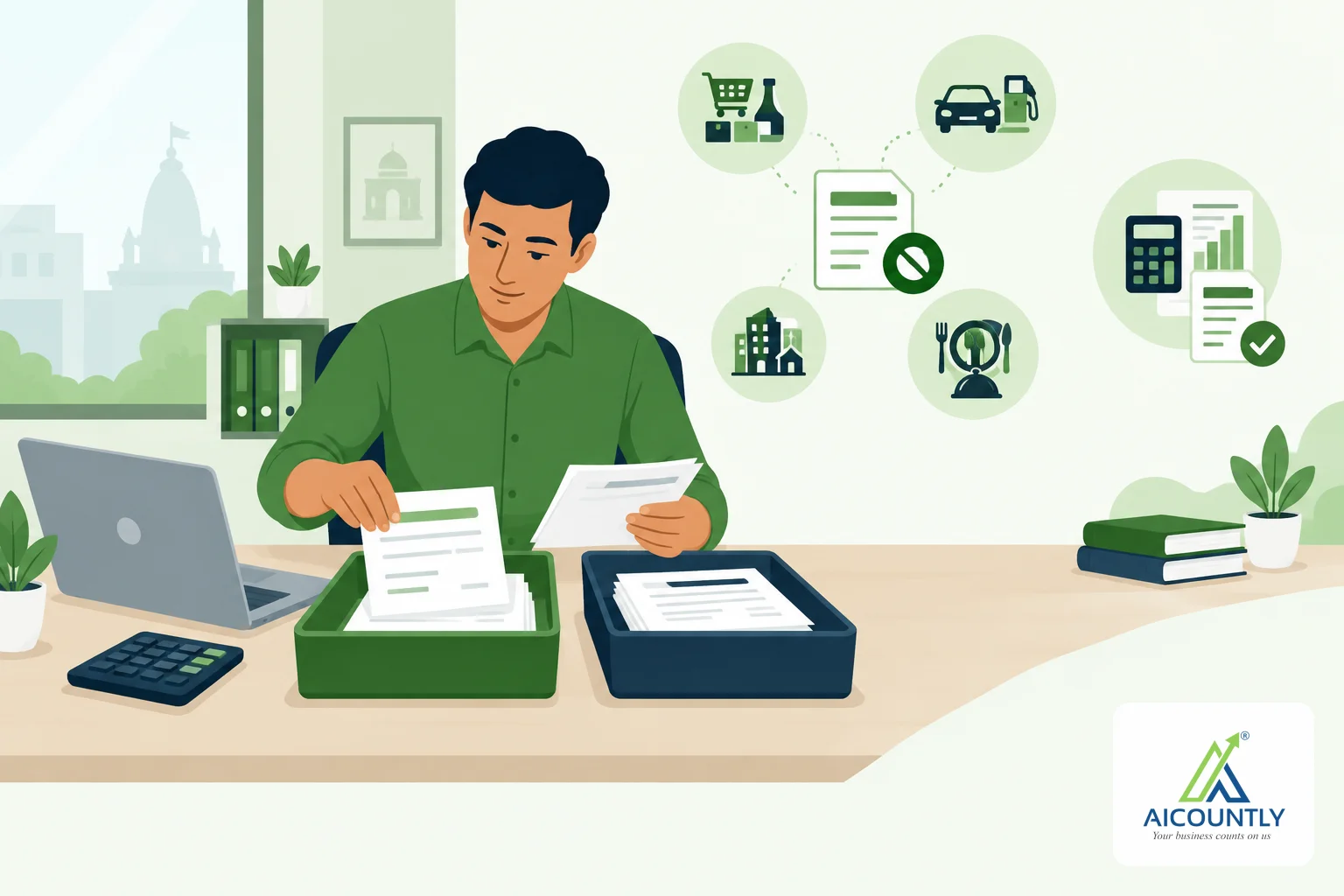
- Motor vehicles for carrying up to 13 persons (including the driver), unless used for specified purposes such as further supply of vehicles, transport of passengers, or training on driving.
- Food and beverages, outdoor catering, beauty treatment, health services and cosmetic or plastic surgery, unless the same category of outward supply is made by you, or providing it is mandatory under a law.
- Membership of a club, health club or fitness centre.
- Rent-a-cab, life insurance and health insurance, except where the law makes providing it obligatory for an employer, or where you supply the same category onward.
- Travel benefits to employees on vacation, such as leave or home travel concession.
- Works contract services and goods or services used to construct an immovable property (other than plant and machinery) on your own account, even where the cost is capitalised. Plant and machinery is treated differently from land, buildings and civil structures.
- Goods lost, stolen, destroyed, written off or disposed of by way of gift or free samples.
- Goods or services used for personal consumption.
- Tax paid under the composition scheme and tax paid in certain demand and detention proceedings.
Always read the exact clause and its exceptions before deciding. A cab hired for a client visit and a cab hired for your cab business are treated very differently.
A worked example
A trader buys three items in a month. A laptop for the office costs Rs 50,000 plus 18% GST of Rs 9,000. A team lunch costs Rs 10,000 plus 5% GST of Rs 500. A sedan for the owner costs Rs 8,00,000 plus GST at the applicable rate.
PurchaseGST paidITC claimable? Office laptopRs 9,000Yes, if the Section 16 conditions are met and it is used for business Team lunchRs 500No, food and beverages are blocked unless an exception applies Owner's sedanApplicable rateNo, unless the vehicle is used for a permitted purposeOnly the laptop's GST goes into your ITC claim. The other two amounts are added to the cost of the purchase.
How to handle blocked credit in your books
- Tag the purchase at entry. Decide at the time of booking whether the invoice is eligible or blocked, rather than at the month end.
- Keep blocked GST out of ITC. Record it as part of the expense or asset cost.
- Report it correctly in GSTR-3B. Table 4(D) of GSTR-3B has a section for ineligible ITC under Section 17(5), and eligible ITC goes in Table 4(A) and 4(C). Check the current form on the GST portal before filing.
- Review mixed-use purchases. If a vehicle or service is used partly for business and partly for personal use, only the business portion is claimable under the rules on apportionment. Keep a note of how you worked it out.
- Reconcile with GSTR-2B. Supplier-reported credit in GSTR-2B does not mean that you are entitled to it. Our guide on GSTR-2B and purchase register reconciliation is a good next step, and so is the GSTR-1 vs GSTR-3B monthly checklist.
Blocked credit versus ITC reversal
These two ideas are related but different. Blocked credit never becomes available in the first place. A reversal takes back credit you already claimed, for example when a supplier is not paid within 180 days. Read our explainer on the 180-day rule under Rule 37 for that case.
Mistakes to avoid
- Claiming credit on restaurant bills and hotel food because the invoice shows a GSTIN.
- Treating all vehicle purchases as blocked, or all as eligible, without checking the use.
- Claiming credit on construction of a building and capitalising the GST without checking the Section 17(5) clause.
- Ignoring the time limit. Credit that is eligible still has to be claimed within the limit in Section 16(4); see our post on the 30 November 2026 deadline.
Key takeaways
- Section 17(5) blocks ITC on specific purchases even when you hold a valid invoice.
- Blocked GST becomes part of the cost of the purchase.
- Check each clause and its exceptions before deciding, as use and business type change the answer.
- Tag purchases when you enter them, and report ineligible ITC properly in GSTR-3B.
- Confirm borderline cases with your chartered accountant.
If you want invoices and purchase entries kept in one organised place so that eligible and ineligible GST is easier to separate, look at Smart Books from AICOUNTLY. This article is general guidance, not tax advice.