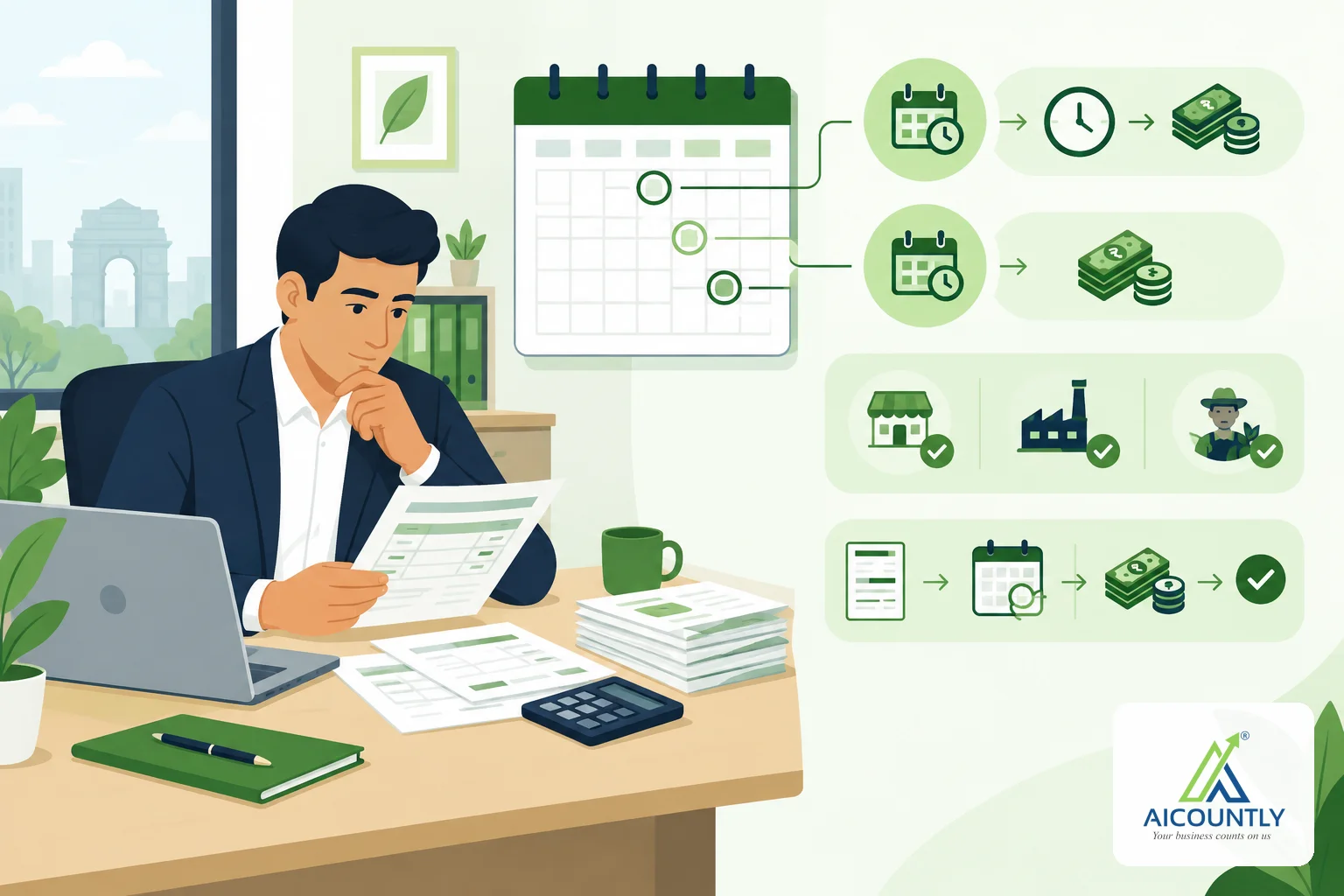
Advance tax is the income tax you pay during the year, in instalments, instead of one lump sum after the year ends. If you run a business and expect to owe ₹10,000 or more in tax for FY 2026-27 after TDS, the next advance tax instalment falls due on 15 December 2026. This guide explains who must pay, how much is due by each date, how interest is charged, and a simple way to estimate your number.
Who has to pay advance tax
As a general rule, advance tax applies when your estimated tax liability for the year, after deducting TDS and TCS, is ₹10,000 or more. It covers businesses, professionals, firms, companies and any individual with business, capital gains or other income that is not fully covered by TDS.
- Salaried individuals usually have tax deducted by the employer, so they pay advance tax only if other income leaves a balance of ₹10,000 or more.
- Resident senior citizens (60 years or above) with no business or professional income are generally exempt from advance tax.
- Taxpayers under the presumptive schemes (for example Section 44AD for small businesses or 44ADA for professionals) may pay the whole advance tax in a single instalment by 15 March.
The instalment schedule
For taxpayers who do not opt for the presumptive single-instalment route, the cumulative payment due is:
Due dateCumulative advance tax to have paid 15 JuneAt least 15% of the year's tax 15 SeptemberAt least 45% 15 DecemberAt least 75% 15 March100%The percentages are cumulative. By 15 December 2026, you should have paid three-quarters of your estimated FY 2026-27 tax in total, including what you paid in June and September.
How interest works if you fall short
There are two kinds of interest for advance tax shortfalls:
- Interest for not paying enough overall: if the advance tax you paid by 31 March is less than 90% of your assessed tax, simple interest of 1% per month or part of a month is charged on the shortfall.
- Interest for deferring instalments: if an instalment falls below the required percentage, 1% per month is charged on the shortfall for the months of delay (three months for the June, September and December instalments, one month for March).
Interest is charged on the shortfall only, not on your whole tax. Still, it adds up if you consistently pay late, and it cannot be waived by simply paying the balance at return filing time.
How to estimate your 15 December amount
- Project the year's profit. Take April to October actuals from your books and add a sensible estimate for November to March. Seasonal businesses should adjust for festival or year-end peaks.
- Compute tax on the total income. Apply the slab rates or the flat company or firm rate, and include surcharge and cess where relevant.
- Subtract TDS and TCS. Use Form 26AS or the Annual Information Statement to see credits that are actually reflected.
- Apply 75%. Multiply the remaining tax by 75% and subtract what you paid in June and September. That balance is the minimum for 15 December.
- Pay through challan ITNS 280 on the income tax portal or your bank, choosing "Advance Tax (100)" as the type of payment.
If your profit has risen sharply since September, pay more in December. If it has fallen, you can pay less, but keep your working on file in case of a query.
Common mistakes to avoid
- Using last year's tax as the estimate without checking this year's profit.
- Forgetting that a payment made on the due date counts only if it is credited by that date; do not wait for the last evening.
- Ignoring capital gains or interest income that arose mid-year. Advance tax applies to these too, and a one-off gain can be handled by paying in the instalment that follows it.
- Claiming TDS credit that has not yet appeared in Form 26AS or AIS.
- Picking the wrong assessment year or minor head on the challan, which delays credit.
Key takeaways
- Advance tax is due when your net tax liability is expected to be ₹10,000 or more.
- By 15 December 2026, cumulative payments should reach at least 75% of the estimated FY 2026-27 tax.
- Shortfalls attract 1% per month simple interest.
- Verify current section numbers and rules on the income tax portal or with a professional, as tax laws can change.
- Keep a short estimate working and the challan receipts for your records.
Pulling the year-to-date profit is much easier when your books are current. If you want a clean half-year position, start with our half-year book closing checklist. For related deadlines, see the guide to TDS and TCS deposits and the post on the income tax return for audit cases. AICOUNTLY's accounting tools are meant to keep your ledgers in order so estimates like this take minutes rather than days. This is general guidance, not tax advice, so confirm your specific position with a chartered accountant.